
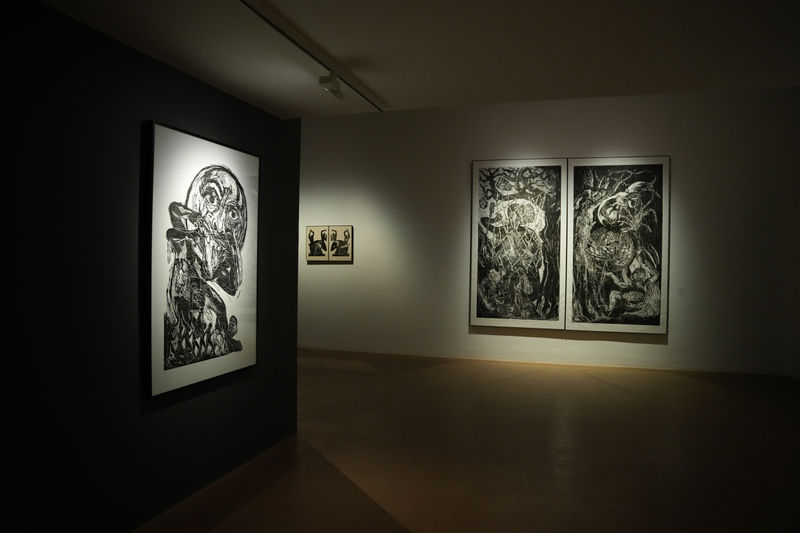
Kolkata-based Arpan Sadhukhan works across woodcut, drypoint, drawing, collage, and sculpture to probe the ideological contradictions that shape contemporary life. A graduate of the Indian College of Art (2018) and the Faculty of Fine Arts, Vadodara (2020), he approaches printmaking not merely as a medium but as a critical methodology. The carved block and the incised plate become sites of inquiry, where acts of cutting, inking, reversal, and pressure metaphorically echo the structuring forces of power, belief and capital.
Influenced by poetry and marxist philosophy, the writings of Rabindranath Tagore and R. Sivakumar, Sadhukhan understands modernism as historically contingent and regionally inflected, yet with universal address. His imagery draws from Kalighat painting and Battala woodcut traditions, set in dialogue with the politically charged figuration of Otto Dix, Bhupen Khakhar, and Nilima Sheikh.
Working in black and white, Sadhukhan constructs hybrid, often grotesque figures that allegorize a world “consumed by greed,” its emotions “covered by neon lights.” His collages Heterology of Ordinary, incorporate fragments from his prints and Nabarun Bhattacharya’s poem This Death Valley Is Not My Land, evoking dystopian unease. Although sharply critical of capitalist inauthenticity, his position remains nuanced, acknowledging the inescapability of market structures even within climate-conscious choices. In the drypoint Searching for the New Born, a burqa-clad policeman stands guard over an egg, staging a tense interplay of protection and surveillance that anticipates an already troubled future and ponders the role of belief and ideological guides in the age of AI. His Wooden sculptures, The Art of Not Keeping the Promises, composed of interlocking blocks, extend the logic of print into three dimensions, drawing the viewer into a fractured architecture of deferred belief.
Together, these works propose an ethics of critical attention, urging viewers to confront the unstable structures - political and economic - that underwrite our present.
- Deeksha Nath